

I Wrote a Substack Essay Every Week For a Year. Here’s What Happened…
reflections on my Substack anniversary

Dearest Reader,
This is week 52. I did it! I wrote 56 articles over the course of a year, only missing one week.
What I set out to do…
My goal was simple - take the first draft of the memoir I was writing, break it into weekly essays, and share it for a year on Substack.
“What I’m thinking now about the book is abandoning the book idea and instead doing blog posts/essays. Take the pressure off a “book” per se. Get into the practice of writing again. Smaller bites. And then maybe one day I turn it into a book. Even as I say this today on the page, it feels like a good idea. It feels more hopeful. We’ll see. See how it goes. Try again. Once more.” Morning pages, January 24, 2025
For two years prior, I debated whether I was allowed to share my personal struggles. Working as a psychologist had shrouded my voice, and I debated how ethical, wise, and safe it would be to write a memoir. Meanwhile, therapists everywhere were talking about their personal lives on social media. Leave it to me to overthink it!
It was an occupational hazard - being a psychologist has meant that most of my days are about the other person. Therapy is about their story and not mine, but somehow I had treated my whole life in this vein. While I’m late to the blogging game, sharing in this manner felt revolutionary for my midlife self.
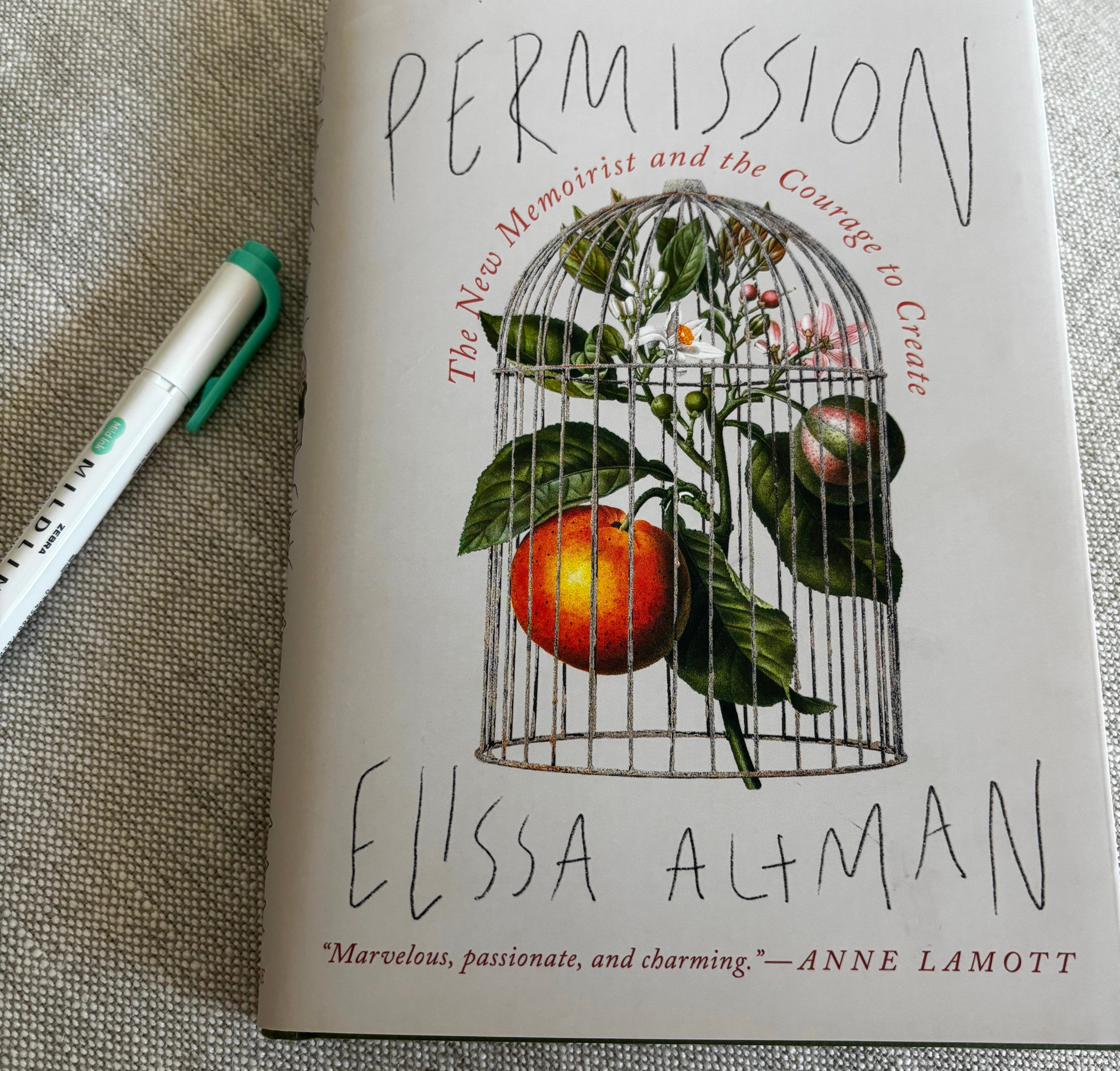
While I felt overwhelmed every time I picked up the draft, breaking it into essays felt manageable. I picked a reasonable goal, ensuring some success and taking the pressure off.
The task was challenging, but not too challenging. Something at the edge of my comfort zone that would push me. Up to that point, only one person had read a tiny section of the draft - I had kept it hidden, to myself.
My essays began last June, and during those first few weeks I felt nauseous when my essays were emailed out. I wanted to hide under the covers, crying on and off, afraid of the potential reception and the exposure.
Stepping out into the light, leaving the quiet corners of the room triggered all my insecurities. Up to that point, I had been the supporting character in the lives of the people around me, and now I was daring to take up space and be known.
What it looked like to do it for a year…
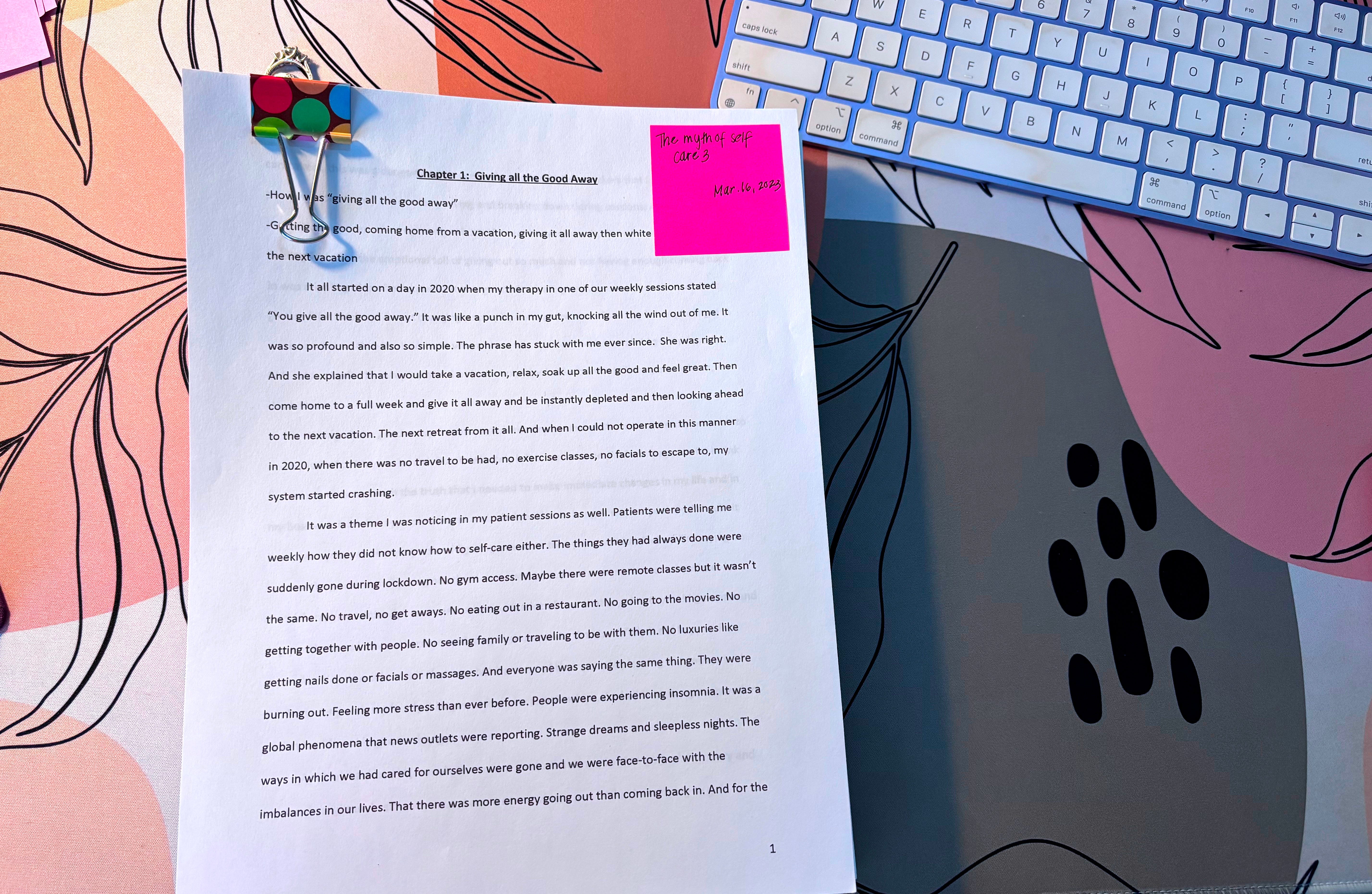
My writing schedule followed a predictable routine. I drafted a new essay on Wednesdays, written by hand with pen and paper. On Thursdays, I added to the draft and typed it up, and Fridays I started editing. I finished edits on Mondays and Tuesdays, I chose photos, decided texts breaks, and completed the layout.
The pace of weekly posts meant I had to stay on track with my time. Unless you have an assistant, all the pieces of Substack are yours and you wear all the hats - writer, editor, layout, photographer, etc. The process was enjoyable - starting with words on the page and then seven days later seeing the finished essay.
During the year, I also released two seasons of a guided journal as a gift for subscribers. (The next iteration comes out in July.)
The weekly cadence meant writing through illness. An unexpected case of shingles blistered down my shoulder blade, a viral infection numbed my mind, insomnia turned me into a zombie and silenced my words. And yet I still found a way to put one word after another on the page. Not every week was outstanding, but “done is better than perfect.”
Substack was a safe-enough place to share. I didn’t import an email list or start with a large audience. Instead, I told a few people and shared with writing friends on IG. While my space has grown slowly over the year, the smallness has provided enough safety to say what I want, try new ideas and build the muscle of sharing.
What worked (and what didn’t work)…
I picked up a few tricks along the way.
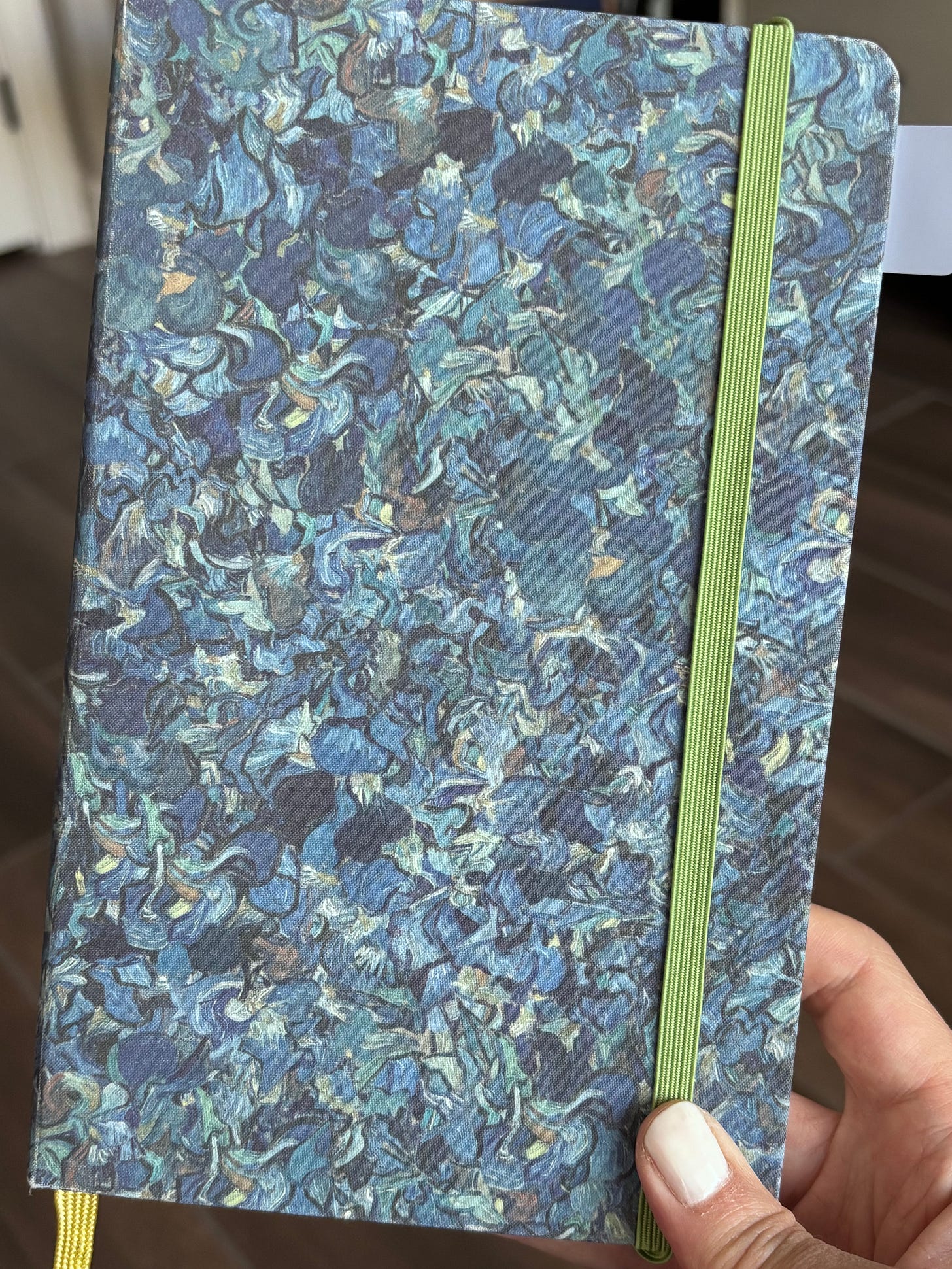
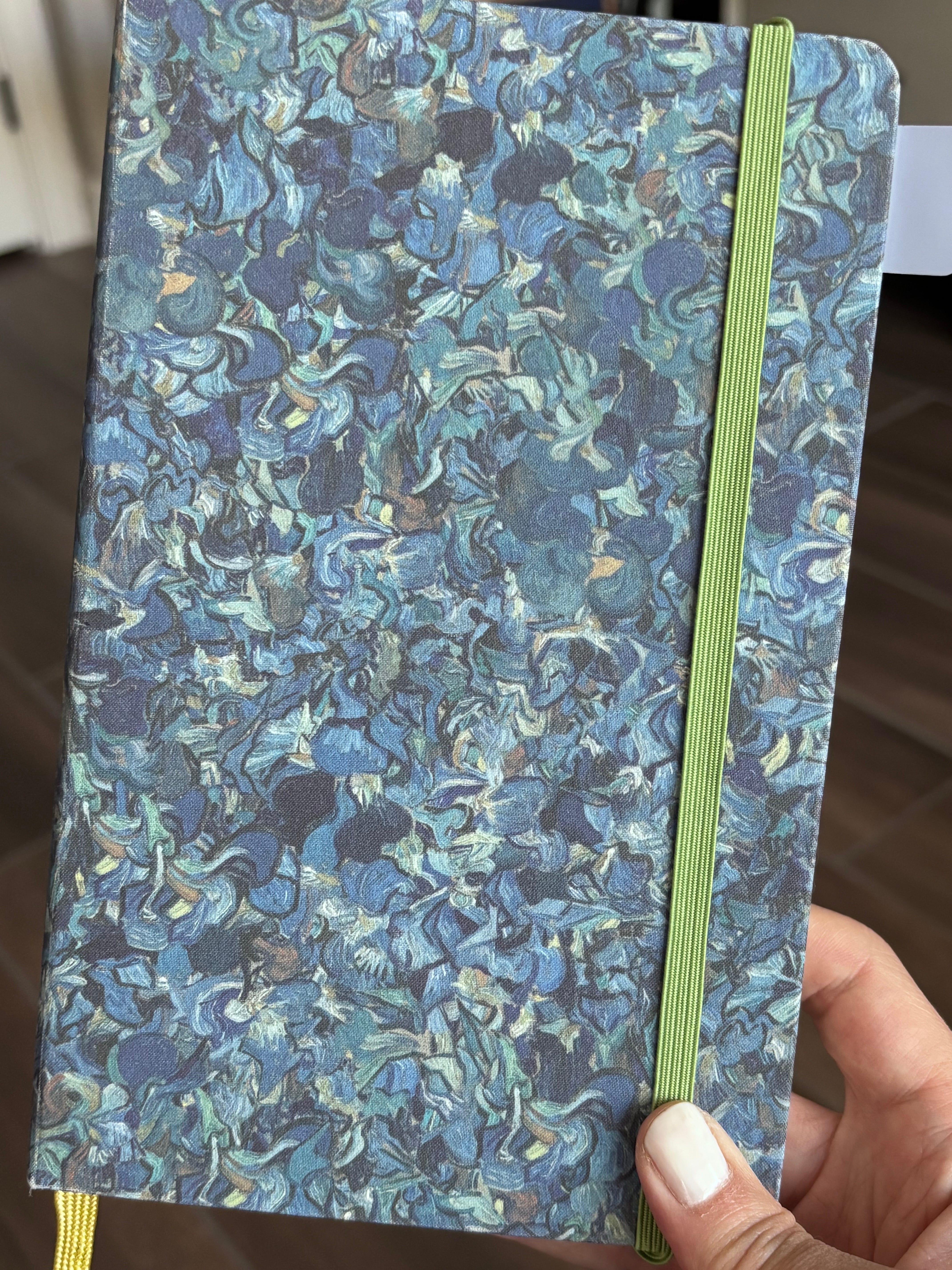
I started a notebook of ideas. When I had an idea or inspiration, I jotted it down (not relying on my memory to recall). Lenny Rachitsky spoke of keeping ideas in a notebook so you never run out of what to write next. I had just the notebook for this purpose - a beautiful Van Gogh-themed Moleskine. Even though I was using my memoir draft as a guide, this helped me expand on thoughts and recall details that fit with the draft.
I ran smaller experiments week to week within the longer yearlong experiment. I tried writing at different times of day, with different writing groups, with pen and paper versus typing, at home, in the backyard, or at a coffee shop. Through these smaller experiments, I discovered what worked for my writing process.
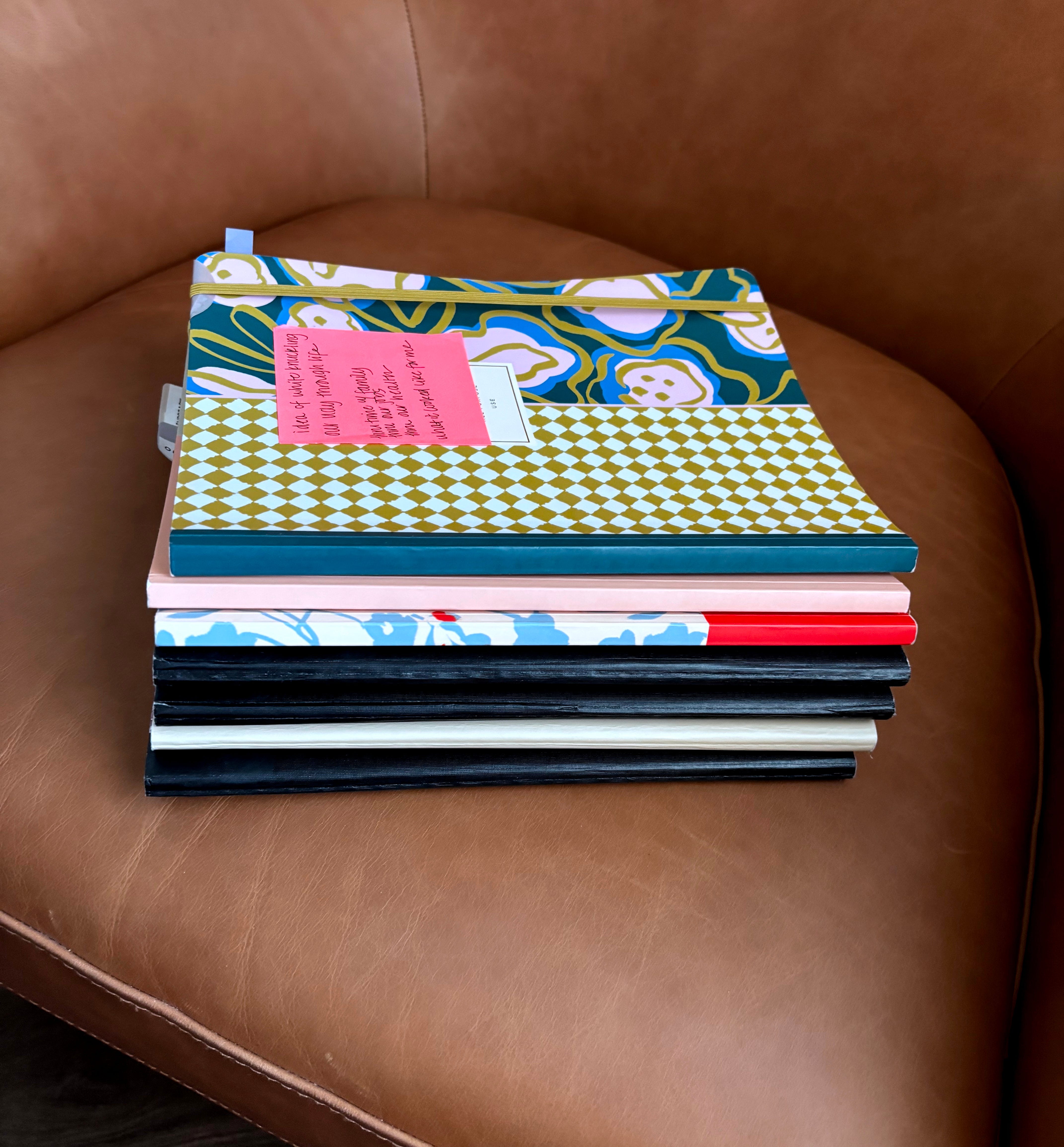
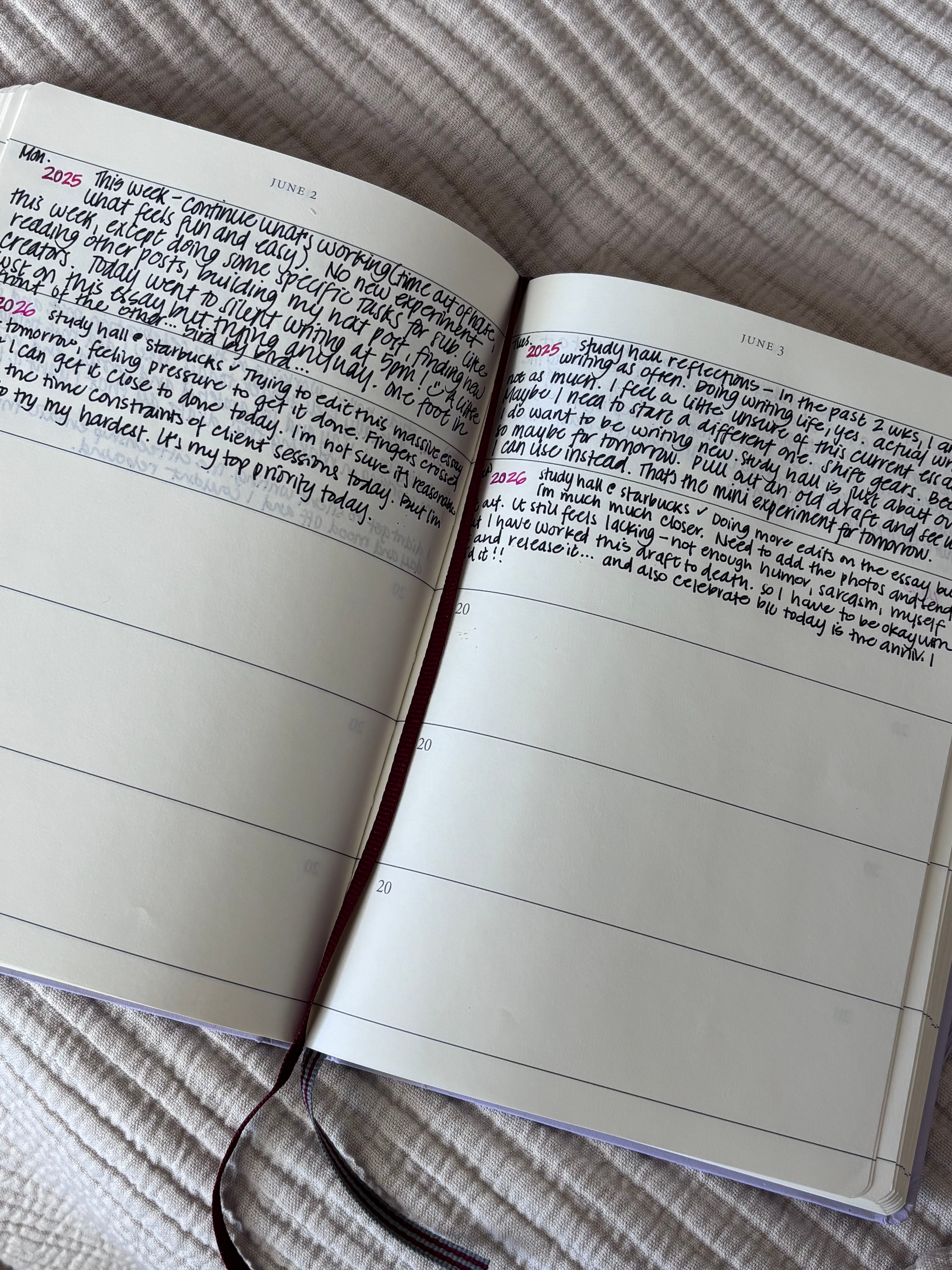
With the advice of my writing coach, I started a process journal. I chose a 5-year notebook from Leuchtturm, and after each writing session, I made notes of what I worked on, what experiment I was trying, how it felt. At the end of each week, I did a plus/minus/next (+ / - / ->) reflection, noting what worked, what didn’t work or what I didn’t enjoy, and how I wanted to tweak the experiment for the following week. Keeping a process notebook served several purposes: (1) it shows my work as irrefutable evidence when the critic wants to say I’m not doing enough; (2) it allows me to track my experiments and make real time adjustments; (3) it provides tangible proof of the growth in my writing.
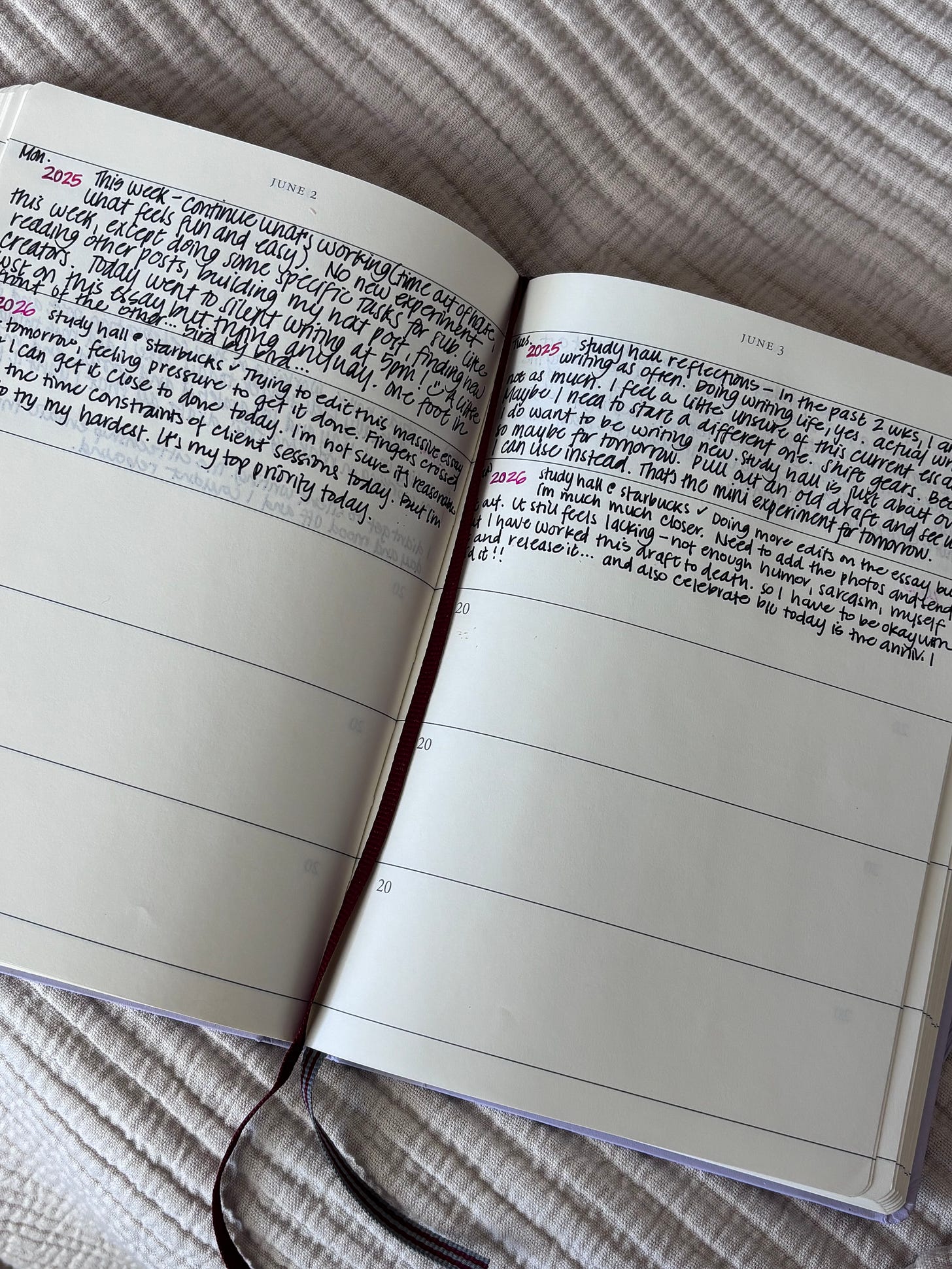
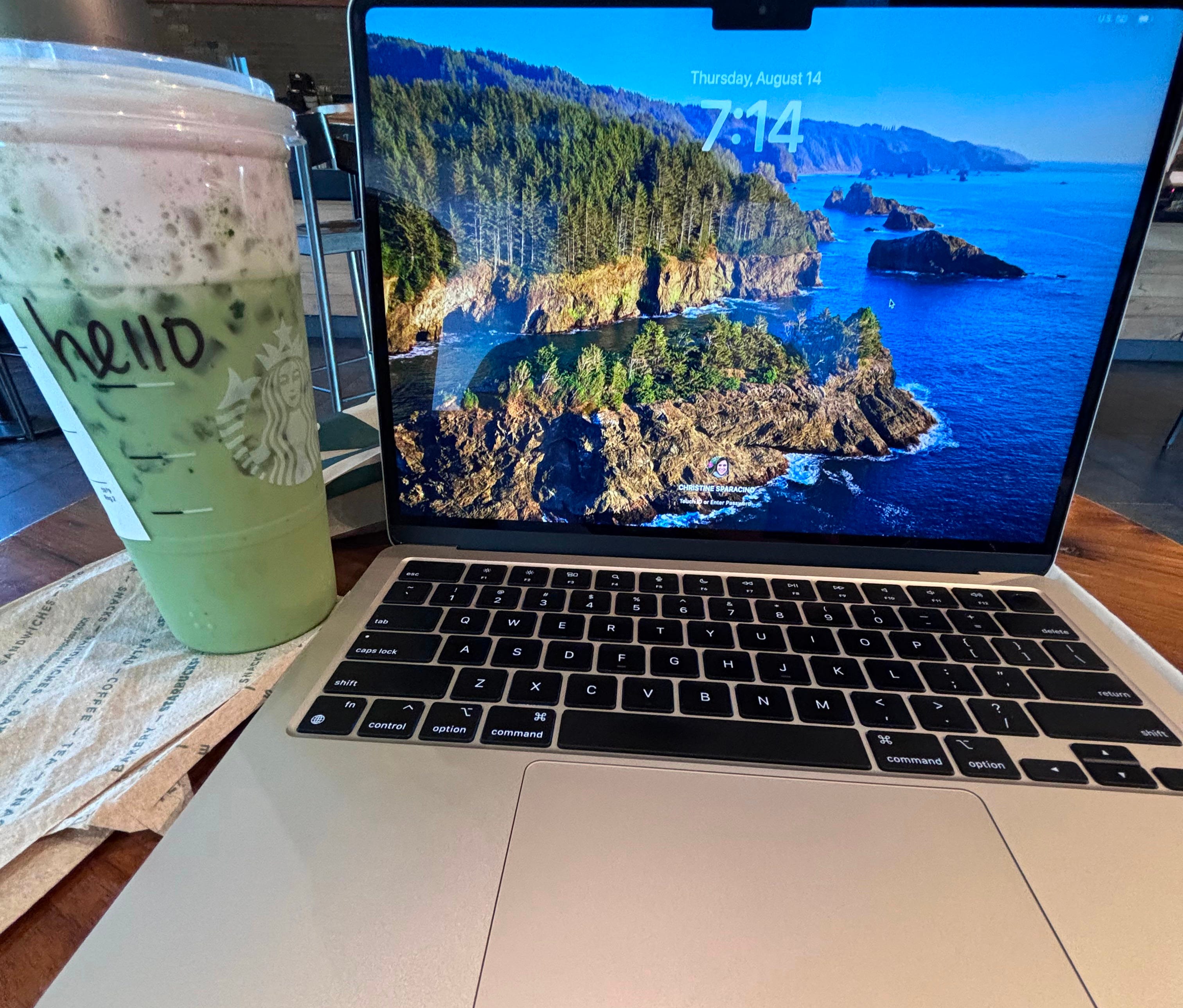
There are several key ingredients to the writing life. They are in no apparent order: adequate sleep, co-writing sessions, being out of the house in a cafe or coffee shop. What I discovered was I need to sleep well enough, I do my best writing in the morning, and being out of my house with all its distractions energizes my work.
Finding people to journey with is an essential part of the creative life. Yes, I can write on my own, but a writing community is the magic. Virtual co-writing makes it easier to show up, like a date I have with Creativity that I never want to miss or cancel. There’s encouragement and camaraderie as we work on our respective projects and stand virtually shoulder to shoulder.
Editorial and content calendars did not work. Advice on Substack says to create editorial and content calendars, but I tried it for one week and realized I couldn’t write like that. Instead, writing in that manner made the experience feel like “work,” and unpaid work at that. I didn’t want to write by some pre-planned schedule but allow the spirit to lead me with what I shared. So I used a general outline of themes to guide my essays. I had a rough idea of the next 1-2 essays in the queue so I was not scrambling for ideas, but I didn’t plan a calendar of “content.” (I also resented the word “content.” Does the world need more content or just more connection?)
What I learned from the experience…
Partnering with Creativity
I learned what works best for me (at least in this season). I learned to show up consistently and build stamina, developing writing endurance from where I started (when I could only focus in fifteen-minute increments).
I learned not to wait for inspiration or to feel like writing, but to show up. I made an agreement with Creativity that I would build a better relationship with her, and consistency was the measure I used to build trust. It showed that I was serious and committed, and over time she emerged more readily. We partnered together - she brought the ideas and the words, and I provided the reliability.
I learned to cultivate ideas from week to week and not to panic. When I sat down to write and no words came, I paused and asked Creativity what she wanted to say, and she showed up every single time.
Staring insecurities down
Substack pushed my buttons and exposed my insecurities. I wanted my story to resonate with you as the reader, to make you feel understood and seen, but I also wanted to be liked. I wanted to grow the list of readers. Sharing my writing in a public forum was like confronting the monster of “likes,” hearts and subscribes. I was writing for myself, but I also wanted external validation.
What started as anxious and insecure became easier. The insecurity has dissolved, and what remains is a momentary twinge when I expose a bit more of myself. I no longer have a vulnerability hangover each week like I did in the first months. The people who have shown up, subscribed, and commented have been gracious and heartfelt, and this offered a salve to my wounds of shame, vulnerability, and insecurity.
The critic
Once I made the commitment, perfectionism in the form of the critic showed up time and time again. To find my way through, I had to lower the stakes on my project. Keep taking the pressure off. I intentionally framed the experiment as a letter from me to you. Whenever the internal pressure rose to do it “right,” I reminded myself, “This is my letter, and it can be imperfect, messy and most of all, honest.”
Over the months, I figured out that the critic showed up the most when I had stripped another layer of vulnerability back and shared more of myself and my past. The critic would try to scare me back into silence. Once I figured out this pattern, I could better prepare the next time.
Connection
Writing connected me with parts of my Self long ignored. I remembered how I loved to play as a child and all the creativity I dabbled with in my youth. I gave myself permission to indulge my notebook obsession, start a sticker collection, and do whatever felt good. Substack brought play back into my life, on the page and off. It allowed me to recover my voice.
Through this experiment, I found flow. Writers speak about it, but it wasn’t until this year that I experienced it for myself. Johann Hari speaks of flow and provides a recipe: Have a clearly defined goal, choose a project that is meaningful and challenging but not impossible. In doing so, I found not only flow, but delight and enjoyment. The last year has arguably been the most enjoyable in my life.
I am the boss
I have learned that I am the boss. I am in charge of this project, and there is no authority figure to tell me how or what, no oversight or rules to follow. I can do whatever I want. This is a space all my own, whatever I imagine, whatever I want to try, and that is a liberating feeling. I learned to trust myself and believe in myself. That my small voice counted in the sea of louder (more successful) voices.
I learned to have fun with writing. How to put the tortured writer cliqué aside and enjoy myself. More than that, when I found enjoyment, I allowed myself to follow it further and to write what was delightful (even if it felt off topic).
The force-field
I learned how to break through the force-field - your writing project has a force-field around it, and once you break through, the words and ideas flow. The work is breaking through!
I learned that taking a week off for vacation would not cause disastrous ruin. Instead, I could return after a break and find my way back in. I wrote without burning myself out. I chose a pace that suited my temperament and paid attention to my energy levels, giving myself rest when I needed it.
What it meant to me…
This experience has changed me. It became much more than just the essays I wrote.
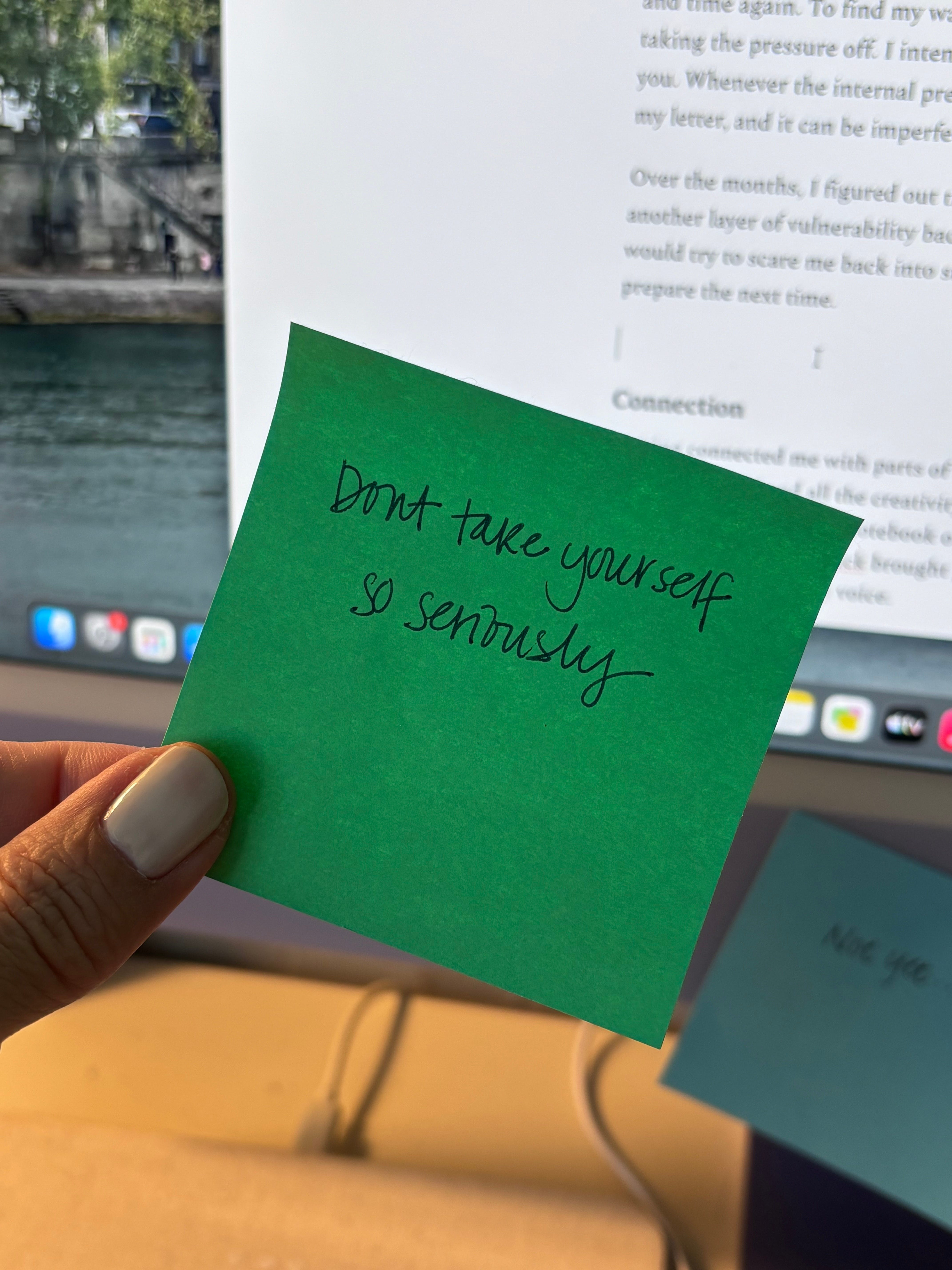
From trembling, tears streaming down my cheeks on that first week to the less fearful, more playful version of myself, I have faced my fears. I have wrestled with my inner critic and danced with my insecurities. I have lowered my expectations and taken myself less seriously.
I have endorsed my own work, not waiting to be “published.” As Amie McNee says - I have coronated myself. I have stood in my voice, claiming ownership of not only my Substack but my life. I am crossing the finish line with more connection to myself and to you, dear reader. It’s like a runner’s high, in part to feeling your support along the way.
My insecurities healed little by little. As people resonated with my essays, the fragile parts of my self-concept healed. Like kintsugi, gold was poured in between the cracks and I was restored. It’s crazy that we do this thing that pushes our buttons, and yet we wouldn’t want to give it up, pushing beyond the limits of comfort each time we sit down and put pen to paper.
This experiment meant freedom to me, stepping out of the cage I had found myself in. It offered an unfolding of my wings, an expansion of my soul.
There were crisis moments along the way, people who said I shouldn’t say the things I was writing, it wasn’t always easy, but knowing that I did the thing that I wanted fills me with the sweetest satisfaction.
I have traveled this year with loving companions and my deepest thanks to them. My husband is the first person to read every Wednesday, and he never stops believing in me. My therapist has listened as I talked through my fears, offering her encouragement. Writing partners have cheered me on, lending their support. My writing group of compassionate creatives has provided solidarity.
Thanks for being here! And for reading this very long post. I’m off to celebrate this creative victory 🍾

Congrats, Christine! This is truly an accomplishment, and what inspires most is how loving and proud you are for yourself. Well done! I thank you for letting us be here in the journey!
I love it, Christine! Congratulations on hitting your goal! But even more than that, all you’ve gained from paying attention to the process, both as it was unfolding and you were learning your creative process and here at the end as you gathered up your learnings.
PS: Love your handwriting, and your process log was so inspiring to see! I remember the idea of the Captain’s Log from Caroline’s writing intensive last summer. 💯